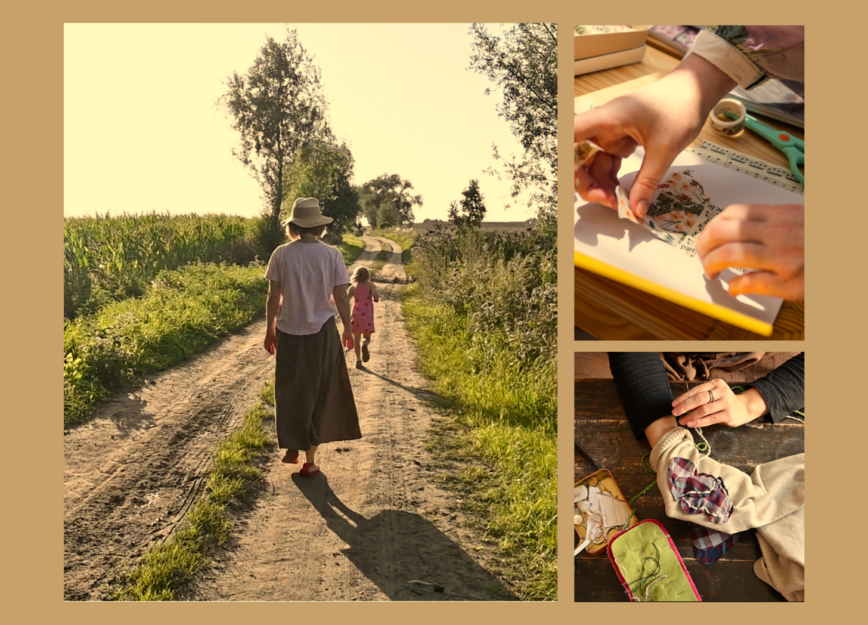
I’ve been practising “creativity with less” ever since I started running my creative art practice in 2005. In my films I always use props and costumes I already have access to. If I need to re-write a scene because I don’t have a certain prop, I’m happy to do it.
I can afford such flexibility because I produce my own films, and I work on low budget productions, which means that I don’t need to ask anyone for permission. Flexibility to make creative decisions has always been important to me but it feels that in 2026 it is a great way to express creative disobedience towards those who want to take creativity and creative expression away from us.
After returning to higher education in 2021, my creative art practice began expanding and evolving towards a multidisciplinary practice. I was able to experiment and have creative flexibility because I reused old clothing and everyday items, which I would have previously thrown out because I considered them unusable.
My decision to re-use broken items was driven by my desire to become a conscious consumer who puts long-term environmental sustainability at the centre of her decision-making process. I was also put off by the pretty expensive arts and crafts supplies.
Re-using textiles, materials and items, which are already in circulation made me experiment more, without thinking about the upfront costs and minimising the need to “play safe”.
Besides using second-hand textiles and giving them another life supports my artistic and personal values.
When any kind of crisis in the world happens, usually the art and creative sector experience disproportional financial cuts. In the world tailored towards growth and consumption financial disregard towards creativity and creative expression isn’t surprising.
So, for me personally being creatively resistant means that financial, global and political disruptions have lesser effect on my ability to run my creative art practice.
Since 2020 globally, we experienced three events, excluding the AI that could have uprooted a lot of artists and creatives, not only those who work on the fringe of the mainstream culture and art.
Having expanded my creative art practice by working with other mediums besides film and writing allowed me to tell stories without requiring additional funding or permission from someone somewhere to tell my story. The expansion and experimentation with various creative forms helped me to take my creative power back, which was the first step in building my creative resistance.
In 2026 I understand creative resistance as:
– Working with textiles, props, costumes and often locations like I did in Anna & Modern Day Slavery, which are already in circulation.
– Work on small budgets, of course still pay my co-creators and collaborators but work on projects that don’t require massive funding before they can become a reality.
– Don’t apply for funding from organisations that don’t align with my artistic values.
– Cut down the external costs needed to run my creative art practice to the minimum.
– Have easily accessible savings.
– Minimise my expenses but don’t minimise fun (fun can be free of charge).
– Have a part-time job that gives me enough income to cover my creative art practice expenses, my kids’ needs and any emergencies.
Neurodiverse POV on Creative Resistance in 2026
It’s not easy to be a neurodiverse individual in general as the world is set up for neurotypical people. But the chaos and unpredictability of 2026 definitely doesn’t help. The pace of how fast everything changes in the global geopolitical situation is overwhelming and feeds my anxiety. If I’m not careful, that can have a massively negative impact on my creativity.
I feel that in order to protect my creativity, my creative self and my neuro-spiciness having a daily self-care routine is vital in 2026. I re-introduced meditation as my daily practice at the beginning of the year. Currently, I meditate for 6 minutes before I start work. 6 minutes is a sweet spot for me giving my body enough time to calm down without causing anxiety that I need to hurry up and start my workday.
I also intentionally removed myself from the news cycle in 2025 and deleted my profiles from FB and Twitter and Instagram from my phone. I still have an Instagram account, which I don’t use.
Apart from YouTube, which some consider to be a social media platform, Substack and LinkedIn I don’t have any other social media platforms.
As a neurodiverse creative, I need to be very careful of where my focus and energy go as I get easily distracted and pulled in many different directions at the same time.
Hence creating practices, rituals and habits that help me stay focused is super important to me.
My practices are usually short, and can be easily implemented into my daily routine.
Part of my creative resistance in 2026 is not to let the craziness of the world outside of my area of influence distract me and take away focus from my creative art practice, my projects, dreams and goals.
PS. I’m made by Made by Dyslexia, so expect small typos and big thinking.
Leave a Reply