B‑certification signals that a company meets verified standards of social and environmental performance, accountability, and transparency to benefit people and the planet, not just shareholders.
I rarely write posts like this, but when a B‑certified company treats durability as optional, and its customers as disposable, it’s worth speaking up especially when the gap between stated values and actual products is impossible to ignore.
I’ve been on my own sustainable, eco‑conscious journey since 2020. For me, conscious consumption means buying fewer things, choosing materials carefully, prioritising vegan options where possible, and most importantly investing in products designed to last.
Sustainability without longevity simply isn’t sustainability in my understanding.
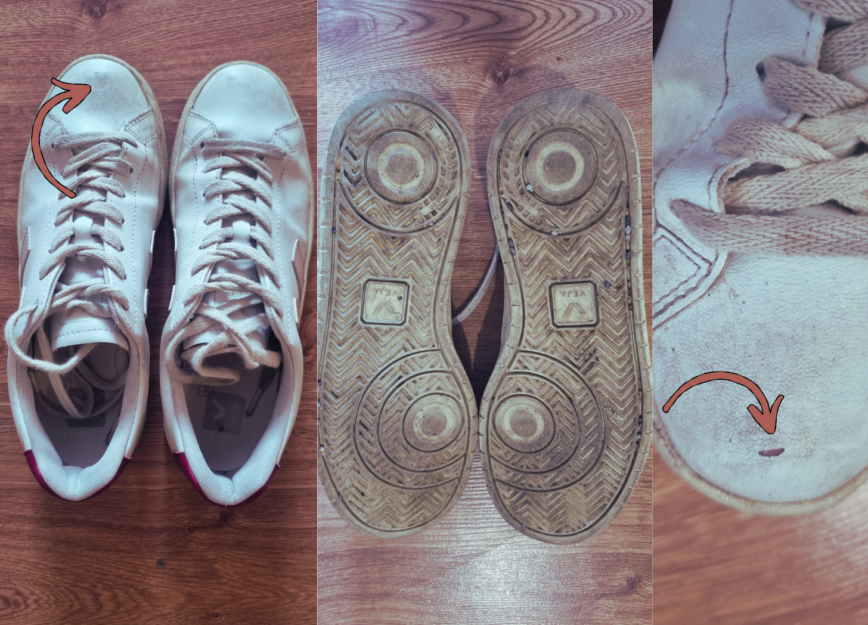
That’s why I believed my vegan VEJA trainers, purchased at the end of June 2025, would be a long‑term purchase. Yet by February–March 2026, after roughly 100–120 wears, a hole began forming at the top of my left shoe. I didn’t even start wearing the trainers until September ‘25 due to the summer heat.
My disappointment with VEJA wasn’t just about the poor quality of the shoes but also about what followed. I contacted VEJA’s customer service expecting accountability or repair support. Instead, the customer service supervisor shifted the responsibility for the damage onto me. (I’m not deluded, clearly this was a corporate policy.)
If a product promoted as sustainable fails within months of moderate use, the issue is clearly with the product. A truly sustainable company understands that durability is a core environmental responsibility, not an optional feature.
The VEJA experience taught me that B‑certification, while useful, is not a guarantee of ethical practise. It can coexist with poor production standards, weak customer support, and products that ultimately contribute to waste.
I will repair and wear the trainers for as long as possible not out of brand loyalty as this one was my first pair, but out of commitment to reducing my personal consumption and not spending money lining the pockets of the corporate goonies.
Going forward, I’ll be even more cautious, looking beyond certifications and prioritising small, local, independent producers and shops whenever possible.
Customer service exchange (summary):
· VEJA acknowledged receipt of my complaint and requested further details.
· I was asked to confirm the place of purchase before any advice could be given. (London UK, Covent Garden)
· I was informed that repairs or solutions depend on where the shoes were purchased (VEJA store vs. third‑party seller).
· No repair, inspection, or assessment was offered at this stage.
· Photographs were provided; after a Google Drive link could not be accessed, images were resent as attachments.
· After VEJA examined the images they decided that the soles of my shoes show that I wore them “too much” (obviously one buys shoes to wear them.)
Appendix: Selected excerpts from customer service correspondence
(Shared for transparency; names and signatures removed)
“First of all, could you please let me know where you made this purchase? I will then be able to advise you on the appropriate steps to take in your situation.”
Why this matters: Responsibility is immediately delegated to point of purchase, not product quality.
“Please note that for purchases made outside of the VEJA website, I encourage you to contact the retailer from whom you bought the shoes.”
Why this matters: Sustainability and durability responsibility is externalised, despite VEJA branding and certification.
“For purchases made in VEJA stores or on our website, please note that an invoice for the purchase is automatically required to proceed with the process.”
Why this matters: Process requirements are prioritised before any assessment of whether a product failure occurred.
“Rest assured that your request will be handled with the utmost care by our specialised team.”
Why this matters: This reassurance contrasts sharply with the absence of a repair or inspection offer.
Taken together, these responses suggest a process focused on purchase logistics rather than durability, repair, or product responsibility.
PS. It goes without saying that I won’t be buying anything from VEJA ever again. But I guess they don’t need me as a customer.
PS. 2 Why is this important? I exchange my time for money, time I’m never going to get back. For my time I’m being paid. The money I earn I exchange for products and I want/expect the products to be durable, especially if I buy products from B-certified companies. As artists and creatives, our income often fluctuates and a lot of us have to have other jobs to be able to invest in our creative projects. For me to run a sustainable creative art practice I need to be very mindful where my money goes. And replacing shoes every six months is the opposite of financial and environmental sustainability.
PS. I’m made by Made by Dyslexia, so expect small typos and big thinking.
Join my YouTube channel
Work with Me
Leave a Reply