Over the last 12 months, the Creative Industries job market has remained turbulent, with more than half of businesses (53%) reporting redundancies. (1)
There has been a 5% decrease in the number of women and non-binary individuals across the Creative Industries (UK) – equivalent to 120,000 departures. This signals a concerning trend around the retention and advancement of marginalised communities in the Creative Industries. (2)
BACKSTORY
Any turbulence in the world’s markets and creative industries suffers. We have seen this cycle time and time again. The most recent one was the COVID pandemic. The moment the world shut down, most freelance jobs were gone in a flash.
From what the Guardian has reported recently (links to all the Guardian’s articles are below), it looks like the British creative industry is suffering yet again. Of course, Brexit didn’t help strengthen the industry, nor did the cuts to the Arts Council England, which were implemented under the previous Tory government. Creative Scotland has also been struggling despite the Scottish government’s last-minute rescue package.
A lot of the funding for the arts and creative industries in the EU comes from central governments, local governments, and Creative Europe. It doesn’t mean getting funding is easier, but in theory, it should mean access to art funding is more equal. When the UK left the EU, it also left Creative Europe, among many other organisations. Hence, the pool of money for art and creative projects shrank. It also became more difficult for British artists to work in the EU countries and for EU artists to work in the UK, which has inevitably contributed to the sector’s decline, as people tend to move where the jobs are.
AI
Recently, the Guardian has been sounding the alarm bells on Labour’s proposal (the party currently in charge of British politics) to sell off creative and artistic work to AI tech companies without compensating the artist. The technology secretary, Peter Kyle, notoriously uses ChatGPT in his daily work and is the brain behind this proposal. Maybe someone in his circle should tell him that ChatGPT isn’t always accurate and sometimes makes up information.
The “logic” behind this initiative is to attract AI money to the UK. For that to happen, the government needs to “give” something in exchange; in the past, those used to be tax breaks. But now, they are flirting with the idea of offering free creative and artistic intellectual property to train the AI models. The plan is for the AI to train without the creators’ or owners’ permission unless the creators and/or owners opt out of their work. The British creative industry calls for an opt-in system instead of what the government is proposing. Read more.
WHAT?!? A WHAT?! (You might ask, wonder and ponder…)
The British government wants to sell something they have no right to sell. The consecutive British governments, starting in the late 70s, pushed for privatising government-owned companies and/or outsourcing previously government-run services to privately owned companies. Without getting too political, it was done to shrink the state and cut costs. The experiment has largely failed, but made a few people very wealthy while crumbling public services such as transport, health care, education, etc. Not everything needs to be privately owned, and no, this is not called communism. I know what communism is; I grew up in a communist state.
Privately owned companies focus on maximising their profits, which often means cutting running costs. So now the British government finds itself in a pickle, having little to sell to attract investment; it wants to sell something that doesn’t belong to it. Of course, Brexit, the pandemic, and the War in Ukraine (Slava Ukrayini) have contributed to the economic decline. However, trying to sell someone’s work without compensating to revitalise the economy is a fucked-up idea.
From what I understand, the decision is still in the works as of this writing. But the sheer idea that any government would openly grab someone else’s intellectual property and offer it for free is seriously messed up. If that comes to materialise, my guess is that the UK will see a massive exodus of creative talent.
THE CRACKS
Another worrying trend the Guardian reported is the TV industry’s slow collapse. According to the article, over the past two years, many experienced TV staff have been unable to secure jobs, as confirmed by a survey conducted by the Major Players. Like during the pandemic, creative talent is back working in a low-paid gig economy, without the benefits of furlough. Reading articles like that breaks my heart, because I know how much time it takes to build a creative career, and believe me, most of us who enter the creative industries don’t do it to become rich. We do it because we love the arts and creative expression. Going back to the jobs one had at the start of their career is heartbreaking. This is not to say that low-paid jobs are below anyone. But to build a life for yourself doing something you love and are good at, and have it all of a sudden disappear in front of your eyes, is agonising. And that happens over and over again when there is any type of financial upheaval or the industry goes in a different direction. Such a system doesn’t retain talent and knowledge, as people who are out of work for longer periods will end up retraining at some point.
The creative industry is not the easiest to establish yourself in; it is highly competitive and notoriously underpaid. In a financial crisis or an emergency (such as COVID-19), the arts and creative industries are the first to go. But at the same time, as a society, we all seek different forms of art or entertainment, and so many of us use creativity to express ourselves or get through yet another day. Unfortunately, the capitalists decided that art and creativity were of lesser value than the manufacturing and consumption of those goods.
SURVIVING FINANCIAL SHAKE-UPS
When I started in the film industry in 2004, after graduating with a foundation degree in new media, I just wanted to tell stories through film. That was right before YouTube and social media. It was a time of massive transition, and no one really knew what would happen. I was quick to adapt to the new realities and to learn, but with that adaptation also came long spells of creative burnout, which I didn’t know how to manage, let alone recognise. I was also much younger, so it was easier just to carry on and dismiss all the signs.
Having lived through many financial crashes and political and economic rollercoasters, I’m 100% certain that anyone in the creative industry needs to have a backup plan or a side gig in case work dries up. (Look at the A-listers and celebrities with all their “side” businesses.)
For our own sanity, it’s important to have money coming in regularly or a large savings or investment portfolio to help us through the hard times. Having a skill that can easily turn into a job in emergency situations or a side gig that keeps the cash flowing is the reality of working in the art and creative industries in 2025.
I had my fair share of low-paid public-facing jobs, which I hated most of the time. Some people like it. For me, it was always a struggle as my inner critic was very “critical” of my life choices, enormously declining my mental health.
Since the art and the creative industry usually don’t pay a ton of money, saving 80% of your income might be rather unrealistic, especially if you live in an expensive city where the majority of job opportunities are. So, what else is there to future-proof our careers, livelihoods, and sanity? I began exploring ways to build a long-term, sustainable art practice during the first lockdown in March 2020. It was a wake-up call for me, and the time to slow down and finally have the breathing space to think clearly, because there were few distractions.
The list below combines what I have implemented in my life and what I have seen others do to make their lives more financially and environmentally sustainable, as they often go hand in hand. One of my strong neurodiverse traits is my ability to see connections between topics, actions, places, and spaces. This ability to connect helped me compile the list below. It’s not a comprehensive list, as I don’t think there will ever be one. But I truly hope it will help you see how you can protect your mental health and your creativity in times of economic instability:
– Start by putting a minimum of 10% towards your savings and investments every time you get paid. When you pay increases, the percentage you set aside should increase as well. But to put money aside, you need to make sure your lifestyle doesn’t inflate as your pay grows. Keep your spending within a realistic budget. I have two neurodiverse kids who need support, so my budget and spending are going to be very different to someone who is single. Follow financial advice from people with similar lifestyles to yours. Otherwise, it can become overwhelming and simply impossible.
– Have at least 3-6 months of your monthly expenses saved in cash and be in a position to stretch that money when you are out of work. Budgeting will help you see where you can make cuts, what is necessary, and what is a lifestyle choice.
– Make sure you don’t have outstanding debts and payments for items you couldn’t afford to pay in cash. I’m not talking about mortgages here, but about commercial, everyday goods such as clothing, furniture, and high-tech items. If you want to buy something, save money; don’t buy on credit.
– Investments should not be touched unless you plan to save for a deposit, a larger purchase, or an investment opportunity. You can invest in the stock market (I know the market is currently volatile, but the market goes up and down and investing in stocks should be long-term). If you don’t believe in stock markets, I suggest you check out Vicky Robin’s book, Your Money or Your Life. She has many practical suggestions on what to invest in if you don’t want to invest in the stock market.
– Having skills you can rely on, such as teaching, speaking another language, playing an instrument, woodwork, plumbing, and gardening, you can fall back on (plan B, C…), is an excellent investment of time and money.
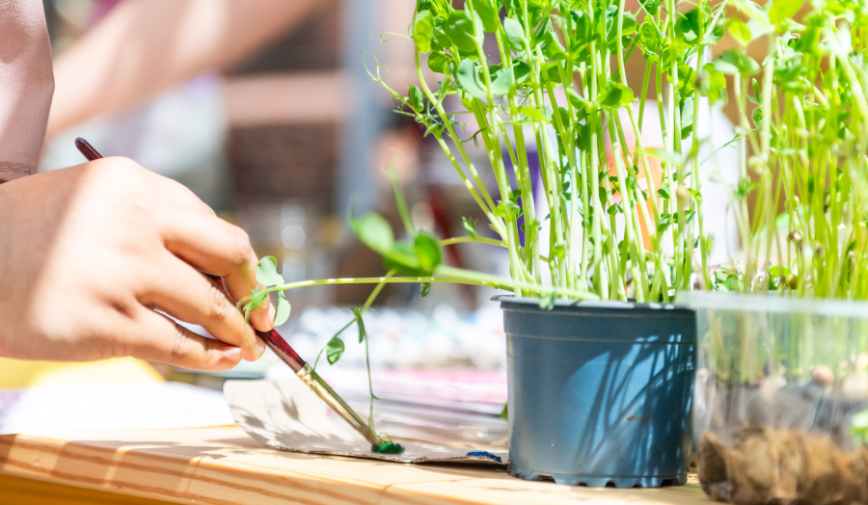
– If you have access to land, a balcony, a back or front garden or an allotment (maybe that could be shared with friends), you could grow your own fruits and veggies, even in the city. Check out this Tiny City Homestead documentary from Happen Films, or my artistic documentary Another Way…. I’m not saying you can become fully self-sufficient. Still, you can grow your own food; this is the ultimate skill in my book. (Deep respect to all the gardeners, farmers and generational knowledge.)
– Mending and making clothes. There is so much fabric available that could be reused. You could do that for yourself, your friends, your community, or set up a side hustle. I have a friend who is an avid knitter, and she knits while catching up on Netflix, etc. You could make dog clothes, which are expensive. How about princess dresses, which are not only expensive but also made cheaply?
– Tutoring students for GCSE and A-levels.
– Yoga, Pilates or, in general, a personal trainer’s qualifications.
– Cooking and baking. You could create a community food exchange program and help feed each other at a fraction of the price. Or sell your food at local markets, a local café or from shop to shop.
– Buying discounted food in supermarkets and Too Good to Go. In some countries, like Poland, Too Good to Go includes supermarket food. Of course, bringing your lunchbox to work and your coffee/tea, if not provided at work, is a massive money saver. I have learned over the years that money should be saved when you have the money, as this creates a deeply ingrained habit that won’t let you massively inflate your lifestyle.
– Skills such as first aid and fire warden training could help you secure temporary jobs with slightly better pay than minimum wage.
– Keep developing skills you enjoy, such as knitting, card making or fixing electronics. The fixing revolution is slowly picking up, so be ahead of the curve.
– Offer your expertise for free to projects or organisations you support or believe in. This is how I landed my current job at the university. I started working on a free project, which led to a paid job and other jobs, projects and more opportunities. Working in higher education has helped me expand my skill set, gain new qualifications and move on from public-facing jobs.
– Selling vintage items or clothing could be a good way of earning extra income. During the pandemic, I met an actress who was selling vintage plates and her own handmade napkins at my local farmer’s market.
– Selling digital assets such as website designs, templates, etc. (That could be a good side gig.)
– Selling workshops and classes based on your very unique experience. If you start building your fan base early on, and I don’t mean thousands of followers who don’t even know who you are and what you do, that could be your safety net for the future.
– Organising or offering your skills for community workshops and events.
– If you can buy a property, maybe buying a property with friends or family members could be a good idea and save you money in the process and in the future. I’m a big believer in buying property, which doesn’t suck up all the money you have or will have. AKA buying something you can afford now, not sometime in the future.
– Keep expanding your skills, especially the offline ones. Having practical skills that can be applied in jobs outside of the creative industries is important. If we assume that many of our jobs will be replaced by AI soon, expanding practical skill sets takes on a different meaning. What practical skills do you have? What do you like doing? What are you good at? What skills would help you become more self-sufficient?
– If you need to recharge your battery, pick up jobs that don’t require much responsibility and let yourself and your brain have a breather. But don’t let those jobs suck the entire creative energy out of you. (This is how I felt in public-facing jobs.)
– If you don’t need a car for your job or commuting, why not hire a car for an hour or two? If you need a car, don’t buy a new one; buy a used one. My relative, a car mechanic, says that older, less computerised cars are the best investment, as all new cars come with software upgrades that consumers will need to pay for, and often have usage limits if you don’t pay extra. Of course, you might want to drive an electric car. If that is the case, look at the second-hand market as well.
Save and invest money when times are good, stick to your budget, invest in quality over quantity, and don’t use credit cards to pay for luxury items you can’t afford. Keep your living costs low and live within your means, not above. Invest in your skills and hobbies, and in long-term, sustainable solutions for your home and household.
Conclusion
Most of us want to have long-term, sustainable careers in the fields we are passionate about. It has never been easy for artists or creative individuals. Still, we can protect ourselves by focusing on financial health, setting long-term financial goals, learning to invest, and looking after our mental and physical health. Thinking outside the box and having alternative income, a self-sufficient homestead, or a tightly knit, supportive community when the job market becomes tight will give us the security we all long for.
I wish you all the best on your quest, and don’t forget to share your experience of living life Another Way 😊
PS. I’m made by Made by Dyslexia, so expect small typos and big thinking.
Bibliography
1& 2. Major Players
Research
https://www.theguardian.com/media/2025/mar/07/tv-producers-industry-crisis-case-studies
Leave a Reply