Read the original post here
2021
I still keep clothes from my crazy 20s because they remind me of the fun I had and the critical milestones I went through.
I’m attached to those items because I loved those experiences so much that the thought of letting them go is too painful.
2025
I still have clothes from my 20s and 30s that I treasure because they remind me of adventures, experiences and feelings associated with them. Now, in my 40s, compared to my 20s and 30s, I don’t buy as many clothes. My attitude towards fashion, shopping and clothes has changed enormously. At the same time, with what I consider a minimalist wardrobe, I feel most like myself in the clothes I wear, which, for someone so insecure and self-conscious about what others thought, is a big achievement.
I find myself reaching for clothing items from 20 years ago (mine & my mum’s) more and more often because of their quality and durability, which are the most important to me at this stage of my life.
2021
Emotional attachment to things is real and can be powerful, especially when it replaces our connection with others or begins to control our decisions, affecting our daily lives.
I’m a firm believer in moderation in life. There is nothing wrong with collecting a little bit of stuff that has emotional significance. However, emotional buying can only recreate temporary happiness and peace of mind. If purchasing gets out of hand, clutter creeps in, and in my experience, it can introduce brain fog, confusion, and an inability to think creatively.
2025
Shopping has never been easier than it is now. The cheap crap (clothes + household items), which has quickly infiltrated our everyday lives, is a real crisis that puts pressure on the environment, our financial stability (cheap items often break & need replacing), and sends signals to mid-range brands that cheap is good, as consumers will still buy it, and willingly replace the item when it breaks. In corporate eyes, it all means profit as they can cut costs on quality.
Based on my experience, the quality of min-range clothing brands and household items has declined significantly since 2021. The focus on maximising profits creates issues for people who want to buy less but spend more on items, as long as it means better quality. To my dismay, fewer and fewer mid-range brands focus on quality.
I now buy clothes and other items from ethical brands or local artists. Still, as I mentioned, I don’t shop that often, so I can save up to pay a little more, especially when buying from an artist. I treat all my purchases as investments, planning to hold on to them until they need to be repurposed or replaced.
Having a minimalist attitude towards shopping and spending helps me keep much of the clutter at bay. However, my kids still accumulate quite a bit of what I consider clutter.
Some people thrive in clutter, while others declutter to the bare bones. I’m not an extreme minimalist, and I like to hold on to items that are dear to me, but anything that starts crowding my space has to go.
2021
For years, I had my son’s kindergarten art displayed in our living room. A few weeks ago, I decided to put it away because it was becoming too dusty—at least, that was my excuse. The moment I tidied up that part of the living room, it “magically” became brighter and somehow lighter. Now, when I look at that spot, I see clarity, while before, it was just unnecessarily busy, adding to my brain clutter.
2025
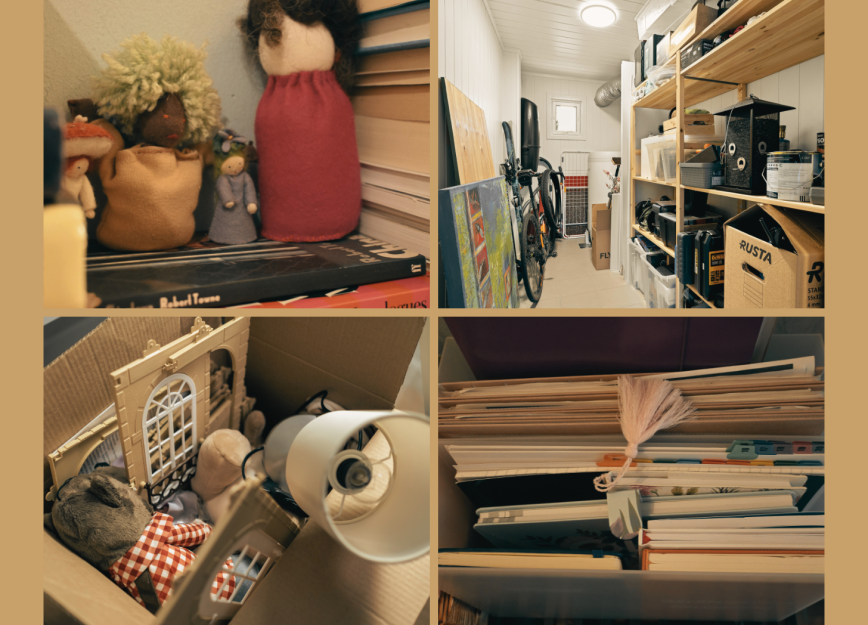
I love my kids’ artworks. However, now my son is a teenager attending 6th form, and he isn’t bothered that all his artwork is in storage boxes. I still keep it.
Instead, my daughter’s artworks fill the space. She is a very prolific artist for a 5-year-old. Just like I hold space for my son’s artworks, I’m holding space for her. Yes, the living room and her bedroom are very busy, but being surrounded by her own artworks makes Baby M. incredibly happy and gives her confidence in her own abilities.
My kid’s artwork holds so many happy memories for me, and I’m not planning to dispose of it anytime soon. I understand that the Minimalists aren’t recommending holding onto items, as it creates emotional baggage and can hinder the decision-making process. But holding on to my kids’ artworks makes them feel appreciated, happy, and indicates that I value their work, which is what counts for me.
2021
As much as I wanted to hold on to my growing son’s early childhood, I needed to make room for growing and changing teenage M. That physical de-cluttering gave me the clarity of mind to accommodate and hold space for his growing needs.
2025
As mentioned above, my son’s artworks are in a couple of storage boxes as I’m holding onto his childhood, which has gone by way too fast.
2021
Whenever I go to my mum’s house for the summer, I obsessively and systematically try to de-clutter her home. However, only recently did I notice her strong emotional attachment to all that stuff. I realised that holding on to all those items had nothing to do with the material possessions, but with the feelings and emotions they evoked in her.
When I asked my mum if I could dispose of old beauty products, some of which were from when my sister and I were in high school, I saw a brief sadness in her eyes. In her eyes/mind, I was disposing of her memories, trumpeting all over her emotions attached to those beauty products from the past. She had a lot of herself invested in all those things without even realising that.
2025
I still declutter my mum’s house, and I’m happy to say that I’ve been making progress, or at least I think so. It’s not an easy task, as clutter is sneaky and easily slips back into spaces and places.
Since I keep quite a lot of my books, some of the kids’ toys, and some of their clothes in my mum’s house, I need to be very selective about what stays, what goes, and how it’s all organised.
A lot of the children’s clothes and shoes were donated to the Ukrainian refugees who came to stay with my mum at the start of the war.
2021
In the world of clever marketers and advertising executives, whose only objective is to sell more and more crap, the human need for happiness and connection is highly exploited. The forever-evolving adverts scream at us: You Need That, You Are Not Enough Without… To Be Part of the Club, You Need…
So, people easily get attached to what they buy, hoping that miraculously, their lives will turn around and suddenly they will belong and find their tribe and their people. People invest a lot of financial and emotional resources in the process of buying, but owning objects rarely brings lasting happiness.
2025
The emotional exploitation by marketers to maximise profit is ongoing, and dissatisfaction tends to grow as we accumulate more stuff. Owning things, we don’t need consumes our life energy, as we have to work to pay for all that clutter. For me, unless an item is essential, it isn’t worth my life energy.
2021
As a society, we have long known that buying more isn’t the way to meet our emotional needs. But a lot of us still do it and can be easily manipulated into thinking that our belongings represent who we are, the class we belong to or the level of happiness we experience.
Objects should never replace memories and daily human connection, regardless of how much the marketers try to convince us they would or could.
Stuff is just stuff; it cannot make us happy or enough. Functional and practical things can make our lives easier, but can’t replace authentic happiness.
2025
I expanded my value system even further, and for example, I started asking friends not to give me any birthday or Christmas gifts. If I ask for gifts, they have to be practical.
Before buying anything, I also consider a product’s end of life, as I’m very reluctant to donate clothing to charities, especially since they struggle to sell many of the items they receive.
2021
Since 2021 is the year of decluttering and sustainable change, I decided that from now on, until the rest of my life, I will only buy things that last. Before every major purchase, I’ll ask myself the following questions:
– How long do I intend to use it for? — If the answer is “just once,” I won’t buy it.
– Do I really need it? — Giving myself a day or a week to decide will allow me to see if this new thing will make my life easier or positively contribute to my life.
– How does the price reflect the quality? — From my experience, if something is too cheap, the quality is not high. There is a reason something costs £1 instead of £10. The positive side of being a consumer is that spotting differences in quality becomes second nature over time.
– Is the item I’m planning to purchase recyclable, sustainable and ethically made?
– Will I be able to recycle the packages or dispose of the item if it breaks down or somehow falls apart? Or perhaps I can fix it.
I hate buying anything that lasts a season or less. Once I dispose of it, I know that it will end up in a dumpster somewhere around the world. Hence, I know my shopping decisions must be conscious, driven only by need and necessity.
2025
The strive towards sustainable change in the way I consume has become a habit.
Before I buy anything, I give myself plenty of time to decide whether I really want it.
I invest in quality over quantity. Unfortunately, in recent years, the quality of items has declined significantly, so instead of buying new items, I try to find clothing and household items in my mum’s house and reuse them.
The perspective of having to buy a new item that was recently produced makes me feel anxious, as I know it’s harder to repair them or, more often, impossible to do so. I also don’t believe my life energy should be devoted to buying crap I don’t need, only to dispose of it in the not-so-distant future or replace relatively new items because of built-in obsolescence.
2021
However, as long as people attach strong emotions to items, such as happiness, feeling wanted/needed, and search for social approval, they will keep on buying, while the marketers will keep on finding even more sophisticated ways of making people feel inadequate. Social media and celebrity throwaway culture are indeed setting unhealthy, destructive trends. You cannot fight global pollution while promoting cheaply mass-produced products, insisting your followers must have them.
2025
To me, the pandemic was the breaking point when cheaply produced, disposable items became the new norm. I know many people who don’t see anything wrong with paying £15 for a pair of shoes that last only a few weeks before they fall apart.
The overconsumption trends and tendencies persist. Still, amidst all the promotion of clutter, underconsumption has emerged, which is a welcome sight, especially if younger generations are adopting it. I hope that underconsumption will soon overtake overconsumption.
2021
Rejecting that kind of marketing message is vital to creating a sustainable life. Owning stuff doesn’t make us wealthier in the emotional or financial sense. For me, spending time with my family and friends, having a job I love, and truly relaxing and unwinding without feeling the social and financial pressure is what happiness is all about.
Saying “no” to fast fashion, gadgets, and status buys will free not only our minds but also our wallets, which won’t have to stretch too far. Instead of obsessively buying new stuff and upgrading the “old” one, we should strive to empower ourselves to feel secure in our lives. Deliberate, conscious actions can create long-lasting real freedom.
2025
Whatever I buy now, I look at it from the perspective of how many hours I need to work to afford the item (I’m talking about the non-essential items or upgrades). If I have to work half an hour to buy a piece of cake, I won’t do it, because for that amount I could bake a whole cake. However, I like baking, and I know not everyone does or has the facilities to do so. What might be non-essential for me, others might consider essential.
Not feeling the pressure to buy something or pay off your credit card because of expanding lifestyle choices is a great feeling. It not only frees up financial resources but also creates space for security, allowing for less stress over money-related issues.
2021
I realise that human relationships with things are unusually complex and that the shift of consciousness takes time. That is why 2021 is a perfect year to start a global movement towards sustainable social change.
After a stressful and emotionally draining 2020, we all need to stand up for the environment, the Rainforest and all the amazing species that live on our wonderful planet. If we don’t stop destroying this planet by buying our way into happiness (to accommodate consumers’ needs, corporations need to eradicate more of our planet’s natural resources), you can bet that more deadly and vicious pandemics will come our way.
2025
I wish it were true that the years of the pandemic had woken us all up and we had taken steps towards rebuilding the world more consciously, but that wasn’t the case. It seems that the version of our reality in 2025 is even more complex and messier than it was before the pandemic. Wars, famines, climate events (climate disasters), growth of social inequality and unrest, and the rise of far-right populist policies have become the norm.
Often, I don’t know how to deal with all this suffering, pain, and destruction; the only antidote to all that negativity I have is creativity. As of this writing, I’m choosing creativity. I also encourage others to be creative because I believe that disconnection from our own creativity and imagination can cause a lot of inner upset, which manifests in various ways, such as anger, frustration, and passive consumption of content, among others. Kids at schools should be encouraged and empowered to be creative, but that is another story.
2021
Suppose we don’t shift our relationship with stuff and start genuinely connecting with people and the surrounding environment. In that case, the marketers will keep on making the 0.1% even wealthier while knowingly destroying Earth’s limited resources.
Collectively, we need to stop associating having stuff with happiness, success and lovability.
In my 20s, I had a lot of stuff I didn’t need, but that was the time when I was the most miserable.
2025
Well, the 0.1% have never been so wealthy as they are now. However, most of them still don’t feel they need to, or should, contribute to society by paying taxes (such as wealth taxes) or by dialling back their greed etc. What makes me wonder is how all those billionaires imagine the world will function if no one, apart from them, can afford to buy their products? People need to feel secure, and having disposable income not only makes life that much more enjoyable but also builds in the security that comes with it.
The class war, or rather the billionaires’ war against the rest of society, is on. They control the politics and legacy media, but still, there are more of us, and there is always a breaking point after which society won’t take any more bullshit. Are we perhaps approaching that point?
2021
It’s not going to be easy to question every single thing I want to purchase. I would need to think ahead and consider its purpose, what I would do with it, and how long I could use it. But I would rather question my decisions than have an influencer or celebrity tell me that to be enough or accepted in the group, I need to buy, spend and own more stuff than I’ll ever need.
2025
I continually question every single purchase, not only from a sustainable and environmental perspective, but also from an ethical standpoint. I want to make a statement and vote with my money, and that attitude or belief has become deeply ingrained in my life. I don’t care about fashion or the influencer and celebrity culture. I want to make my own decisions, which I believe are in the best interest of me and my family. To honour that commitment, I deleted my social media accounts. The only account I still have is Instagram, which is accessible only on my computer, and I no longer post new content on it. I keep it open to communicate with some friends. I also stopped reading the FIRE blogs and posts. I stopped relating to them, as my lifestyle, including my career choice, didn’t align with the majority of their experiences and advice. I also don’t feel comfortable investing in the stock market, which is all about never-ending growth (hence the poor quality of goods nowadays and built-in obsolescence). The Earth’s resources are limited, and the constant growth based on exploitation isn’t something I want to be associated with.
In 2025, I listen to my experience, my needs more than I ever have.
For the past few years, I’ve been working to build a long-term, sustainable creative art practice that reflects my values, current needs, lifestyle, and my growth as a conscious human and an artist.
2021
We are all enough without all the extra clutter that only weighs us down, limits our possibilities, and deprives us of fantastic opportunities we could have had if it hadn’t been for the constant pressure to spend.
2025
In 2025, I still stand by this statement, and I’m even more disconnected from the pressures of keeping up with the consumer culture and, in general, the culture of having to be someone I’ll never be.
In 2025, my focus has shifted to establishing a long-lasting, sustainable creative art practice that can withstand financial shocks and be environmentally friendly (I create my work using materials already in circulation).
Leave a Reply