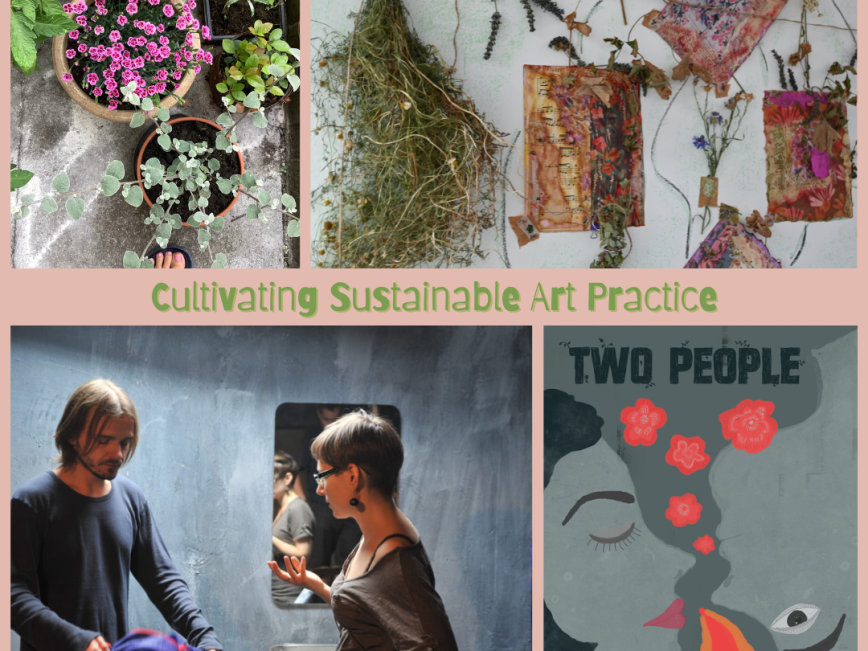
This approach not only helps me keep the costs of my projects down, but my choice to work with whatever I have access to has a smaller environmental impact. I don’t feel that having “lesser” choice of physical resources has a negative effect on my artwork; I feel it’s quite the opposite, as I’m presented with a challenge that stimulates me to think outside the box.
Businesses outside the art and creative industries have been making environmental pledges (keeping those pledges is a different story and another post) for years now. Some of the companies are doing better than others, but because of the pledges and the environmental conversation moving from the fringes to mainstream media and culture in general, people are much more aware of the impact their choices have on long-term environmental sustainability (the big corporations and governments need to catch up with the conversation and the public demand).
Since we all live on a resource-limited, finite planet, artists and creatives must also play their part in preserving Mother Earth’s beauty and sustainability. In my opinion, the environmental legacy we leave behind is equally important to the art we create.
As for me and my practice, the list below represents what I usually do (my film & video productions are tiny budget productions, so they might not reflect what larger film & TV production companies do, but I’m sharing with you links below on how larger productions can engage in sustainability):
While on film sets, I:
- Use second-hand costumes. I often check my wardrobe or check what the actors have in theirs.
- Reuse props. I either use items I have or borrow them from family and friends.
- Reuse locations to double up as other locations or use existing ones (9MM). Using the same locations reduces transport pollution. Also, using existing locations means I don’t need to invest in building them. If I have to build anything, the materials used to build the sets will be reused later. (The Man with the Spying Glass or Anna & Modern Day Slavery)
- I usually have a cooking station on the film sets, and homemade food is provided. I avoid buying ready-made lunches and dinners to reduce packaging waste. I do buy packaged food, but I try to keep it to a minimum.
- There are no takeaway coffees or teas in disposable cups or small plastic water bottles. Everyone needs to bring their own cups and bottles. (I can’t provide any as I work on very small budgets.) Of course, I provide coffee, tea, and water, and I’m happy to pay for any of it when shooting exteriors, as long as people have their own bottles and cups.
- If the production has to travel to a location, I use as few cars as possible for transport, and the crew and cast share them. If public transport is available and the production is not moving from that location for the day, it would be the option. (OFC that includes equipment tracks.)
- Use natural light whenever possible.
- I try to use locations that don’t require much travelling to and from.
- I don’t overshoot footage as I’ll need to store it somewhere physically or in the cloud.
While creating any of my multidisciplinary artworks:
- I reuse the pots, soil and plastic containers to plant and replant. I always save the small pots for growing seedlings, and I often get pots donated because my neighbours know I have an urban balcony garden, which is part of my art practice.
- I reuse art supplies and never buy anything new until the old is finished. It stretches my imagination to work with less and lets me reuse all the things the kids aren’t using anymore.
- I reuse fabrics from old clothes and wool from projects that didn’t work out for me.
- I buy items in charity shops, such as frames, to hang some of my artwork in.
- I collect items I might use in some capacity for future projects. I often don’t know what I’ll use them for, but if I have a strong feeling I need to keep them, I keep them.
Electronics & Internet
- I usually buy secondhand electronics or returned items.
- I often clean out my inboxes so my unwanted emails don’t clutter the cloud.
- I’m connected to power when I need to be, not all the time.
- I use offline editing software.
- I don’t use iCloud for storage, but an old-fashioned external hard drive (this is my personal preference, as data centres require a lot of water to cool, and they are often built in places that already experience water shortages). I’m also concerned that Claud’s services might delete work without notifying me.
- I don’t use AI to create my visuals or videos. Maybe it’s a mistake as I’m not “streamlining” my workflow, but this isn’t only my preference but also my way of protecting the artistic and creative work of others, for which AI companies don’t pay.
This is my list, which I’m sure will change over time. I will update it as I grow as a consciously environmental artist and cultivate my sustainable art practice.
I would love to hear from you. Please share your experience or understanding of environmentally sustainable art practice.
PS. I’m made by Made by Dyslexia, so expect small typos and big thinking.
Leave a Reply