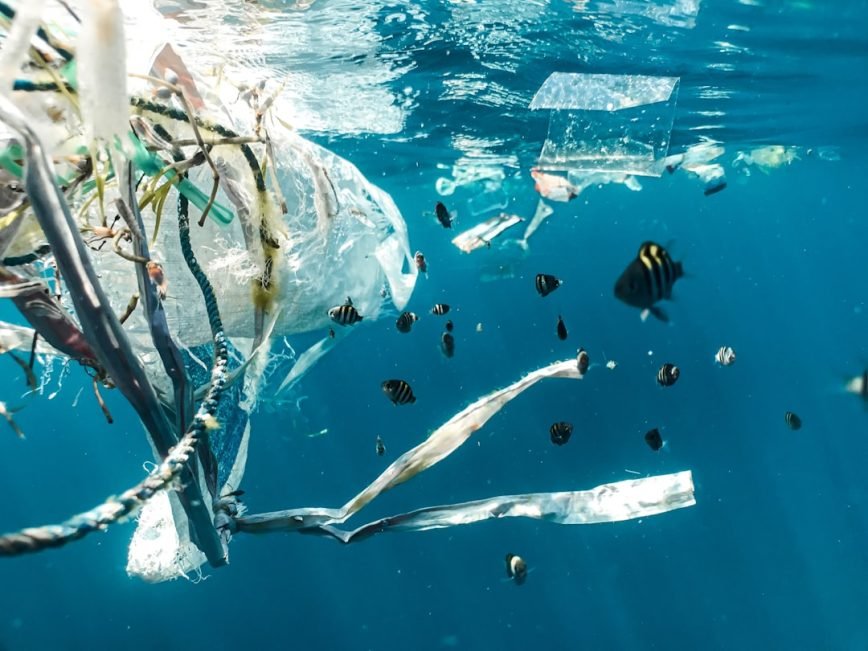
Over our lifetime, each of us creates, on average, 512 kgs of bathroom waste. Some of those items, such as contact lenses, will never decompose.
I’ve been trying to ditch plastic from my bathroom products for years. Unfortunately, it feels like Sisyphus’s job, since most of my products come in plastic. I honestly try to shop for products in glass containers. Still, in some instances, it’s close to impossible to find a replacement that is high quality and won’t leave me in a poor house down the line (the astronomical costs of products in non-plastic containers are significant factors keeping the public from replacing plastic).
As for me, the simplest product to replace was soap/shower gel. The trickiest part is finding a soap bar without an extra layer of plastic wrapped around it. In practice, it means I must be fully aware and mindful, even while shopping for soap. It takes up to 450 years for a shower gel bottle to decompose, so replacing plastic containers with soap bars should be the first thing everyone does.
It has been pretty tricky for me to replace the shampoo. The bar shampoos I tried weren’t good. I tried several brands, and all were as bad as the previous one, leaving my hair tangled and in a state of despair. As of this writing, the only solution I can see to the shampoo bottle problem is for the public to aggressively lobby companies to set up refill stations in shops and supermarkets, or to use bottle-collection/refilling services.
The naysayers will point out that this kind of switch and upgrade will cost a lot of money and that there is no infrastructure to implement such a change. But the reality of leaving behind a legacy of empty, non-compostable shampoo bottles isn’t something we should be neglecting. Companies must do more to help turn that nightmare of an ecological disaster into a workable solution. Necessity is the mother of all invention, and I believe that companies can and will turn a profit even with substantial investments in sustainable solutions.
Other bathroom products that can be easily replaced are toothbrushes, wet wipes and razors. Toothbrushes can be swapped for electric toothbrushes with recyclable heads, and small flannels can replace wet wipes. Metal and bamboo razors should be used instead of disposable razors. It takes 100 years for a wet wipe to decompose and 400 for a toothbrush, so it should be a no-brainer that we all swap those products.
Since the political and corporate powers are rethinking our economic model, or at least I strongly hope so, redirecting the economy and jobs towards a greener and more sustainable economy and solutions should be the primary objective of governments and the corporate world in the post-COVID economy.
Shampoos, lotions, toners and facial creams must all come in refillable bottles. Without an exemption, all shops need to offer affordable refilling facilities without cheeky, hidden costs that the customers have to cover on their end. As long as refilling isn’t made easily accessible and part of our shopping routine, I feel it will be hard to reduce plastic waste from our bathrooms.
Another issue that is much less visible in our everyday bathroom products is the plastic microbeads used in toothpaste, shower gel, and other cosmetics. Once washed off, they cause a severe threat to marine wildlife. Hence, buying products without microbeads is always a priority. Keep microbeads on your radar, and if unsure, check the ingredients. Sometimes, companies use fancy words to confuse us. If I buy a new product that includes a confusing ingredients section, I usually put it away. From my experience, I can say that companies that produce organic products typically have nothing to hide, and the ingredients they use are listed on the label.
As of this writing (Feb. 2021, I’ll be re-visiting and updating this post at the end of the year.) I use facial creams in glass jars or metal tubes. I have an electric toothbrush for everyone but baby M., who has a biodegradable one, and of course, we use soap bars.
This year, plans to replace facial wash and toner, shampoo, toothpaste, and body lotion. For now, we are using the only toothpaste that comes in a recyclable tube, but still, it’s plastic.
How will my switching go? I have no idea, because it’s not easy to find a high-quality product that is also good for the environment. I also don’t know how expensive this change will be since products that don’t come in plastic containers still tend to be pretty pricy.
I know that some people are skilled and determined enough to make their products, but that is out of the question for me. I’ve travelled that road before and ended up buying a gazillion ingredients, mostly in plastic bottles; however hard I tried to make the washing-up liquid work, I couldn’t crack the secret. In support of my experiment, my hubby tried his hardest to clean the dishes with whatever I made, but it was unusable.
Conscious and mindful shopping sounds like a lot of work. Still, we have no choice but to become mindful consumers who make smart choices with our money. Everyone can, in an instant, make small changes in their lives without waiting for politicians to pass laws or corporations to change their wasteful ways. The time to act is now.
I’m looking for affordable, high-quality products that cause less damage and, in the long run, have a positive, lasting impact.
PS. I’m made by Made by Dyslexia, so expect small typos and big thinking.
Leave a Reply