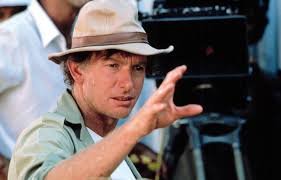

The name of Peter Weir is known to almost every film fan. Who hasn’t raved about and been frightened to death watching his most famous film Picnic at Hanging Rock? With this film, already at the very beginning of his career, Weir ensured himself an honourable spot in the history of film and ensured the world paid attention to the cinematography of Antipodes.
 Peter Weir, born on the 21st of August, 1944, is an alumni of the Australian Film Institute, founded by Jerzy Toeplitz. However before he even chose to be a director, he studied law at Sydney University (he didn’t graduate) and worked at the family company trading in real estate. In 1965 he travelled to Europe. The meeting with the Old Continent allowed Weir to look distantly at Australia and noticed problems originating from the collision of the different cultures. This subject has been ever-present in his many works.
In 1967 he took a job working for the television company Channel Four, which induced him to make his first short films: Man on a Green Bike (1969) and Michael, a segment of the Three to Go trilogy (1971).
The works of Peter Weir can be divided into two periods: Australian and Hollywood. The Australian period was opened with the grotesque and black-humoured films Homesdale (1971) and The Cars That Ate Paris (1974), being part of the Australian gothic. Both films are linked by the similarity of convention and plot structure. Homesdale’s plot is set in the secluded – „spa” in which guests are getting macabre treatments by the sadistic administrator. The Cars That Ate Paris tells the story of the peaceful Australian small town, situated amid the immense desert where the citizens make money from fake car crashes. They sell the spare parts and carry out medical experiments on the casualties. Told as a horror The Cars That Ate Paris was a big hit in the Australian cinemas.
Not wanting to make people wait long for his next film in 1975 Weir realised a masterpiece of the world cinema Picnic at Hanging Rock, the film described in almost every modern book on the history of film. This fascinating and disturbing film, on the borderland of awe and horror, includes and at the same time opens most typical subjects and plots of his later works.
The plot of the film is based on a seemingly authentic fact. On the 14th of February, 1900 pupils of the Victorian school for girls, run by the caustic madame Apple yard, set out for a picnic from which a few of them, along with their teacher, went missing in unexplained circumstances. Only one of them was found. The fate of the rest remained unknown.
The ill-fated picnic happened to take place under the titled Hanging Rock. The girls, motivated
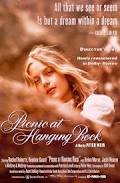
by curiosity, rebellion or mysterious impulse walked away from the leading group and got lost amidst the rocks. The sound and the music score in the film underlines the magnetic and hypnotic effect of the Hanging Rock which seemed to summon its victims. Were they victims? The missed girls were provoked to set out by the sensitive Miranda, who appeared to be very charismatic and drew them behind. From the beginning of the film, when we meet her in school, she is shown as a creature from another world, an oniric angel. The other girls followed her without hesitation to meet the Mystery. The tragic disappearance of the girls may be interpreted as a symbolic passing, an initiation, gaining a higher form of awareness. There is a good reason that the school world starts falling apart after this event. Parents take their daughters away from the school, and Madame Appleyard falls into ruin, both financially and psychologically. The main subject of the film is the collation between the rigid etiquette symbolised by the school and the uncontrollable bush lying in wait just outside the school walls and symbolised by the Hanging Rock. This is a film about the consequences of the collision between different cultures, about the problems of New England artificially transplanted to Australia and among its indigenous habitats.
Similar reflections are included in The Last Wave (1977), The Plumber (1979) and The Mosquito Coast (1986). The main character of The Last Wave is a lawyer, David Burton, who undertakes to defend few Aborigines accused of murder. Along with the progress of the trial, Burton gets to know the culture and habits of people who have been living in Australia for centuries and were pushed to the margin by expansive white colonists. Together with the Aborigines the disturbing and mysterious culture turns up which changes the protagonist and gives him the knowledge of the world of magic and ceremonials. Incomprehensible and arcane for the whites. Defending the Aborigines and desiring to understand their position Burton is forced to enter their world and their ceremonies. While getting to know the Others, he also gains knowledge about himself. The Last Wave is a critique of the western mentality and arrogance of the whites. Both, the director and the audience sympathise with the victims – the Aborigines. The Last Wave takes the subject of glorification of the native aborigine culture, characteristic of the Australian New Wave.
The subject of The Plumber is the collision between the high culture represented by the anthropologist Jill and the working class represented by the demonic plumber called to repair the bathroom. The convention used before in The Cars That Ate Paris and Homesdale is back once again. So black humour and the stylized convention of horror/thriller. The cloddish and loutish plumber makes Jill confront her own sexual identity and causes her to rediscover her feminity.
The Mosquito Coast (1986) is a film already belonging to the American period. Weir moved to the United States in 1984 and had been successfully making films there ever since. The Mosquito Coast again recalls the problems of the civilised white people thrown into the world of the aboriginal settlers; this time played out in the South American jungle. In Witness (1985), similarly as in The Last Wave, the American lawyer plunges into the airtight world of the American Amish commune. It allows him to look critically at his own culture and find shelter in the community alienated from the modern world.
One of Weir’s most essential films realised after he emigrated to America is without a doubt The Truman Show (1998). The film is a virulent critique of the consumptive society and the omnipotent television ruling over the government of souls. It is almost a model exemplification of the simulacra theory by Jean Baudrillard, according to which we are witnesses to the process of reality vanishing in favour of virtuality, created by media and computers.
The main protagonist is Truman Burbank (Jim Carrey in one of his finest performances), from his birth „trapped” in a TV reality show and unaware of the manipulation. We meet him when he starts suspecting that something is not quite right and tries to escape from the fake world he was put in. The film tells of the tragedy of a man awoken from „the sweet dream” of virtual reality which he was treated to by the show creators and masses of fans allowing them to do so. Grotesque and tragicomic The Truman Show aims the needle of criticism at the callous media and their audience who without the shadow of hesitation allow it to „imprison” themselves in front of the TV screens gladly peeping at the lives others.
Also, the touching Dead Poets Society (1989) and Fearless (1993) should be mentioned. In Dead Poets Society once again Weir goes back to the conservative school training young souls, the scenery known from Picnic at Hanging Rock. This time the charismatic English teacher John Keating (Robin Williams) tries to pull these poor souls out from the disciplining and punitive ambience. Fearless explores the plots of discovering one’s own identity and searching for the depth of one’s being in the face of death.
His last picture, so far, is Master and Commander: The Far Side of the World (2003). The next picture The Way Back (2010), a story about soldiers who escaped from a Siberian gulag in 1940 is in post-production.
Weir likes disturbing the audience. He touches difficult and inconvenient subjects, introduces riddles and mysteries, builds oniric visions and puts the viewer in the face of complicated problems. He explores the subconscious, and the areas pushed to the margin, forgotten and the ones others don’t speak of. He asks a lot of questions and often leaves them unanswered. His films draw from different species: horror, thriller, but also comedy and psychological drama. He easily passes from the popular cinema on to the artistic one.
 Thanks to him actors such as Mel Gibson, Jim Carrey and Robin Williams have developed their dramatic skills.
Chosen Filmography
The Way Back (2010)
Master and Commander: The Far Side of the World (2003)
The Truman Show (1998)
Fearless (1993)
Green Card (1990)
Dead Poets Society (1989)
The Mosquito Coast (1986)
Witness (1985)
The Year of Living Dangerously (1982)
Gallipoli (1981)
The Plumber (1979) (TV)
The Last Wave (1977)
Picnic at Hanging Rock (1975)
The Cars That Ate Paris (1974)
Three to Go (1971) (segment Michael)
Homesdale (1971)
Man on a Green Bike (1969) (TV)
Chosen Awards
1978 – Special Jury Award @ the Avoriaz Fantastic Film Festival for The Last Wave
1981 – Best Director Award @ the Australian Film Institute Awards for Gallipoli
1990 – BAFTA Award for Best Film for Dead Poets Society
1998 – Screen International Award @ European Film Awards for The Truman Show
Leave a Reply