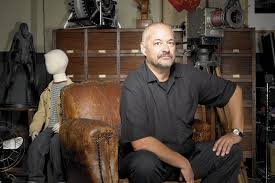

Jean Pierre Jeunet, one of the most renowned French directors these days. He never attended any film schools, and he learned his craft by making short films, commercials and video clips.
He was born on the 3rd of September, 1953 in Roanne, France. He has been interested in cinema since childhood. His favourite (directors) were Marcel Carne and Jacques Prevert. Except for directing films, Jeunet also worked as a film critic for two magazines: ‘Fantasmagorie’ and ‘A Suivre’.
For a long time, he cooperated with his friend Mark Caro. They formed a very original duo, which landmark was first and foremost the visual conception of their projects. With special pleasure, they were using macabre, grotesque, black humour. They created eccentric characters with typically vivid images. In 1978 they made together with the animated film L’evasion, and in 1980 another animation, Le Manege, for which they won the Cesar Award. Around that time Jeunet was awarded two more Cesars, one for Pas de repos pur Billy Brakko (1984) and the other for Foutaises (1989). In the meantime Jeunet made his first live-action fiction film Le bunker de la dernier rafale, telling of soldiers trapped in a basement.
The breakthrough in the duo’s career appeared to be their feature debut Delicatessen made in 1991. The film developed plots started in one of Caro’s short stories La concierge est dans l’escalier. The film, filled with a claustrophobic atmosphere, is a macabre story set amongst the degenerate inhabitants of a gloomy, dingy tenement building in some indefinite, post-nuclear future. The house is ruled by Butcher Clapet, who offers human meat products. This low-budget production gained a group of loyal enthusiasts and established the positions of Jeunet and Caro as the experts for surrealism and film macabre decorated with black humour. The film was awarded four Cesars, received some awards at the Sitges International Film Festival of Catalonia and was amongst others also nominated for some BAFTA Film Awards.
They’re next and also the last project they created together was a surreal fairy-tale The City of Lost Children (1995). The director of photography was again Darius Khondji, who worked with Caro and Jeunet previously on Delicatessen. The costumes were designed by Jean Paul Gaultier, and the music score composed by Angelo Badalamenti. The entire film was shot inside a studio and visually resembles the works of German expressionism. The story of lonely Krank, living on a mined drilling rig that is not capable of dreaming and kidnaps children to steal their dreams is a gloomy fable about human feelings and searching for closeness. Two worlds clash there. The imperfect, stiff and soulless world of adults clashes with the spontaneous, vivid, optimistic world of children, full of humane reflexes. Krank kidnaps children to regain forgotten parts of his soul and to awaken the child within him.
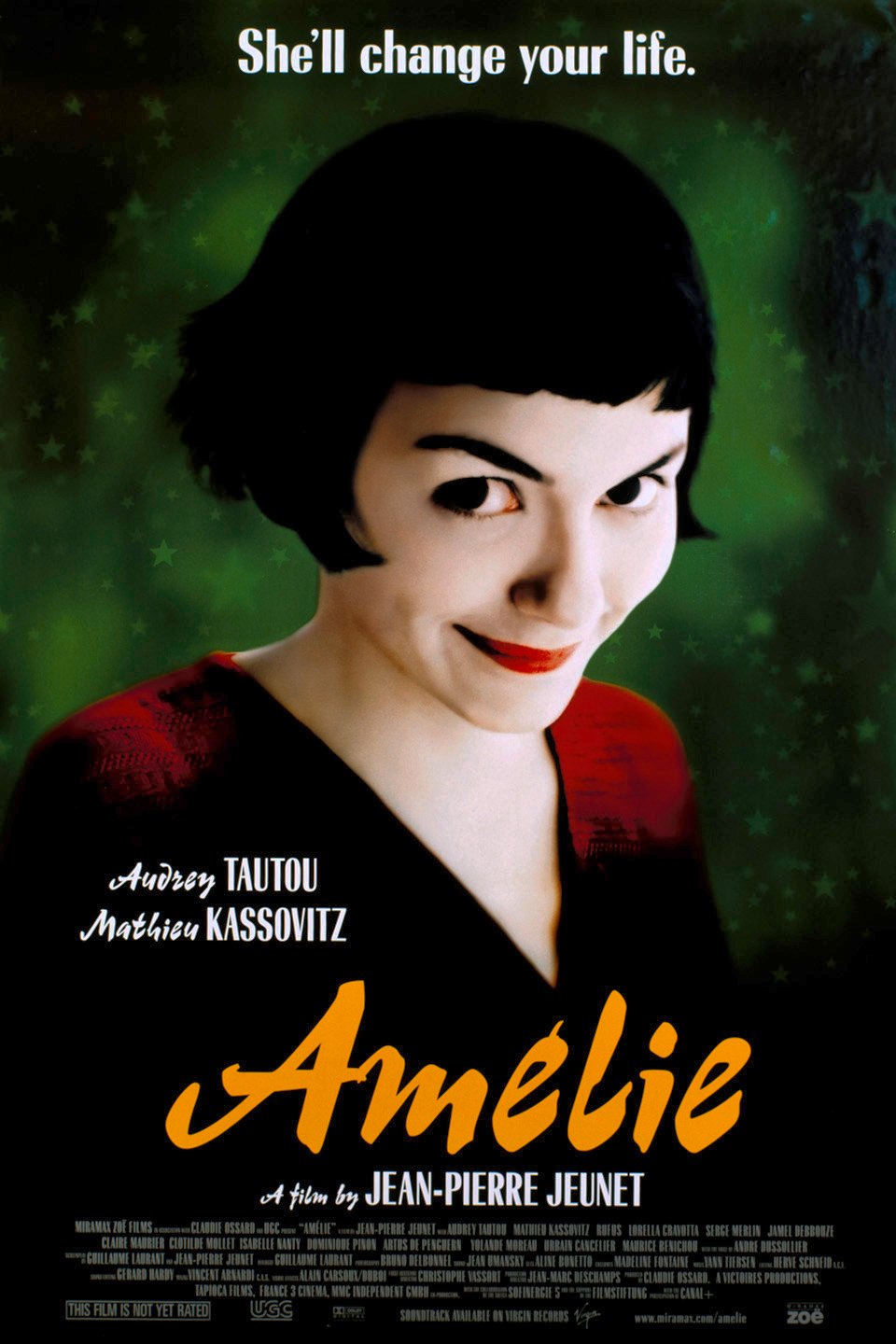
The praise of spontaneity and joy of life brought the best known of Jeunet’s’ films Amélie, which even made the name of the cult film. The script was written by Jeunet and Guillaume Laurant. The film started the big international career of Audrey Tautou, exceptionally apt in the role of titled Amelia. Jeunet depicted a positive and optimistic vision of the world, in which one does not have to do much to work miracles. Ingenious and a bit nutty, Amelia has an exceptional sense of endowing people with happiness, and she does it with great intuition and grace. Filled with positive energy and subtle femininity Amelia lives as if beyond real-time, in a surreal and magical reality which she creates herself in no small degree. She expects nothing from others. She endows with happiness gratuitously, and this process itself is a source of joy for her. Amelia arouses common sympathy, and the audience identifies with her with pleasure. As well as the director himself who said: “Amelia is me”.
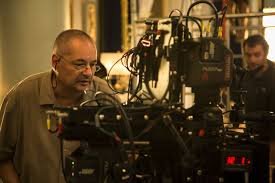
So far Amelie is the most renowned film of Jean Pierre Jeunet, for which he was awarded among others with four Cesar Awards, the European Film Award, the European Film Audience Award, the Grand Prix of Karlovy Vary Film Festival and the Independent Spirit Award. On top of that, he was nominated for the Oscars, Golden Globes and BAFTA awards.
In the meantime, 20th Century Fox offered Jeunet an opportunity to direct the fourth part of the Alien series. Jeunet accepted it and in 1997 went to Hollywood to make Alien: Resurrection, in which next to Sigourney Weaver and Winona Ryder, he cast his favourite actor Dominique Pinon. Unfortunately one of Jeunet’s main crew members Pitof, responsible for the visual effects caused the visual side of the film to overwhelm the main plot. In the foreground is mainly dynamic action with bloody and pretty disgusting special effects present almost throughout the whole story.
Luckily, after his Hollywood accident, he came back to France to realise A Very Long Engagement (2004), a screen version of Sebastien Japrisot’s book. This fable war melodrama is set during World War I. The primary role of Mathilde was again entrusted to Audrey Tautou. A story presented by Jeunet is entirely anti-war. It’s the story of a young woman from Brittany who does not want to believe that her fiance had been killed on the front line. Determined and stubborn she decides to do whatever it takes to find her fiance. Jeunet juggles with the world of war tragedy and the coexistence of it with the paradise of childhood when Mathilde returns home and the world of chic Paris, both so different from the reality of entrenchments.
Jean Pierre Jeunet works in the ‘Cinefondation’ society, which supports young filmmakers’ debuts. Amongst others, he was also the president of the short films jury at 1998 Cannes Film Festival.
Filmography:
1978 – L’évasion
1980 – Le manège
1984 – Pas de repos pour Billy Brakko
1989 – Things I Like, Things I Don’t Like / “Foutaises”
1991 – Delicatessen
1995 – The City of Lost Children / “La cité des enfants perdus”
1997 – Alien: Resurrection
2001 – Amélie / “Le fabuleux destin d’Amélie Poulain”
2004 – A Very Long Engagement / “Un long dimanche de fiançailles”
2009 – Micmacs / “Micmacs à tire-larigot”
Chosen Awards
1991 – Cesar Award for Best Short Film – Fiction for Things I Like, Things I Don’t Like / “Foutaises”
1991 – Gold Award at Tokyo International Film Festival for Delicatessen
2001 – Jury European Film Award and Audience European Film Award for Amélie
2005 – Edgar Allan Poe Award for Best Motion Picture Screenplay for A Very Long Engagement
Leave a Reply