The original post was written in 2021. Since then, a lot has changed in the world and on my personal journey toward conscious living. So it was time to revisit this post…
How to Read this Post
Each fragment is categorised by the year it was written. The 2025 writing reflects my continually evolving approach, thoughts, and understanding of the world.
If you would rather read the post from 2021 first, without the 2025 comments, you can find it here: How to Shop With Purpose in a World of Excess
2021
The year didn’t start with a massive bang for us, but it did with two movies, which I always consider a good start to the year.
However, four days into the New Year, BJ (Boris Johnson, the British Prime Minister) announced yet another national lockdown, which wasn’t that surprising.
2025
In total, the UK had three national lockdowns.
BJ, who was the Prime Minister (PM) during the pandemic, is no longer in that position. In fact, the Tories (the party he belonged to) lost the 2024 general election. Labour has been in power since July 2024. However, it’s unclear how different their policies are from consecutive Tory governments. Labour’s lack of compassion and understanding of the daily hardships people face is real. The financial, economic, social and ideological struggles since the pandemic have only increased, creating division and polarisation in society.
2021
The next day after the announcement, we learned we needed to buy a new car seat for baby M because the one we had lent out had been returned to us broken, though none of the people who used it before even bothered to tell us. (No comment)
2025
Baby M. is already six, so she already has another, more grown-up seat. The COVID car seat was passed on to someone else (price – chocolate). In an ideal world, I wish there were a system where car seats could be rented, allowing parents to avoid the upfront cost of buying them (they’re not cheap). In reality, if you don’t manage to pass on the car seat to someone else, it will end up in a landfill.
There needs to be a better way to manage the end of life of products such as children’s car seats, as, apart from financial costs, it takes a significant amount of resources to manufacture one.
2021
Our dishwasher broke down on January 6th, and even though we tried to repair it, we might need to replace it sooner rather than later.
2025
I’m happy to say the dishwasher, since Jan.2021, has been repaired once more and hasn’t been replaced yet. This is what I call sustainability 😊
2021
This morning (I’m writing this on January 9th), our car’s engine started flashing, and it wouldn’t start. Luckily, the insurance sent a really nice lad who jump-started the car, gave Big M. a few tips, and maybe, just maybe, we only need to replace the battery.
2025
Since January 2021, we have swapped our car for an electric one. Because we live in London, just right outside the Ultra Low Emission Zone, with which a lot of the Londoners didn’t agree with.
In short, to get to the park or the shop from where we live, we needed a car that would let us cross the ULEZ without paying each time we went over the South Circular. Don’t get me wrong, I’m very happy with the electric car we have, but I’m not sure that forcing ordinary people to change cars without any financial incentive or support is the best way to go about that. I understand that change is needed, and I’m all for it, but financial support should have been put in place first.
2021
I have to say that none of the obstacles above has fazed me in any way. I wasn’t panicking, I wasn’t worried, and I wasn’t scared that we didn’t have enough money to cover all the unforeseen expenses.
However, that wouldn’t have been the case if I had only seen money through my consumer’s eyes. Because I managed to shift my perception of money and what it can really offer, I kept my spending low and savings pretty high compared to what I used to do.
Still, I have a long way to go to align my consumerism with environmental standards.
2025
Since my early days of saving and investing (I didn’t start doing any of that until March 2020), my savings and investments have grown quite a bit, and I:
-changed jobs (I work part-time at London Metropolitan University, so I can devote the rest of my working time to running my creative art practice),
-paid off my postgraduate loan (honestly, people, before you take a postgraduate loan, talk to others who have done it. I personally wish I hadn’t taken the postgraduate loan or the undergraduate maintenance loan. Instead, I should have used my savings to pay for the postgraduate school. It was a financial mistake.)
-went on a few holidays,
– bought a flat in Poland (the flat is still waiting for remodelling).
With the unpredictable world outside my windows, inflation out of control (the UK is not doing too well compared to other countries across Europe), my desire and determination to save and invest, while at the same time building my creative art practice, which is financially sustainable, has grown even stronger.
If there is any financial instability in the world, the arts always suffer first. The art sector across the UK is shrinking once again and shrinking fast.
Considering how much everyone relied on arts, entertainment, and culture during the long days of the pandemic, it is sad to see that the political class doesn’t see the arts as a necessity for human survival.
2021
Global overconsumption needs to go, and it’s not a choice anymore but a necessity if we don’t want to leave this planet uninhabitable for our kids and grandkids.
2025
The global overconsumption didn’t disappear at all. New companies (not mentioning them here) came into existence, polluting the planet with their disgusting products made often not to the EU standards. However, many people still buy those products because an item only costs £10. Well, if you pay for a pair of boots, £10 don’t be surprised, they won’t last a week.
Unfortunately, the decline in quality of goods has occurred across many sectors.
Why would any company invest in quality if people want cheap, fast and under £10?
2021
To meet my new sustainability goals, I decided to investigate ways and solutions to transform my household into a more sustainable place.
Plastic waste — reduce plastic waste in any possible way. I’m going to start with my bathroom. I’ve been slowly replacing plastic, non-recyclable toothbrushes, soaps and creams. But I know I need to push even harder. This year I plan to replace all the everyday products I have in the bathroom, either with reusable containers or find substitute products in glass containers.
2025
I have been reducing plastic over the years as much as I can.
Some of the plastic in my bathroom has been replaced, but I haven’t been able to replace others, such as toothpaste (the toothpaste tablets and powder don’t work for me). I have not been able to find the right shampoo and conditioner for my hair. The ones that I buy in my local zero-waste shop don’t work for me. So, occasionally, I buy shampoo and conditioner in a plastic bottle. When it comes to beauty products, I buy toner or facial wash at zero-waste shops, and occasionally moisturisers. However, for example, factor 50 sunscreen is not something I can get in a zero-waste shop, so I need to buy it for the summer in plastic tubes.
However, I always reuse what I already have before buying anything new.
2021
I’ve been using the Ecover refillable bottles for years. However, finding local shops that carry those products at affordable prices is still hard. I hope it changes this year so I won’t have to consider the price alone. Ecover should do much more to make refillable stations accessible and affordable to the general public. How can refilling one container be more expensive than buying a new product in a new plastic container? Ecover, you need to step up!
2025
Well, Ecover didn’t step up its game. But that shouldn’t surprise me at all, as Ecover is owned by S.C. Johnson & Son, and since when has a multinational corporation prioritised the environment over profit? Profit is always the king. However, thanks to the zero-waste shops, I moved on from Ecover and use whatever products they have in store. Some washing-up liquids aren’t that good, but I would rather use a product that isn’t “perfect” than buy a bottle a week.
2021
Plastic waste in the kitchen is my worst enemy. We eat lots of fruit, and most of it, for some unknown reason, comes in extra plastic packaging in the UK. Over the past few months, I’ve been buying more loose fruits and veggies. The supermarkets are also changing; it’s a slow one, but finding loose kiwis, lemons, mangos, or pears is becoming more common.
Despite those efforts, I still end up with plastic from other fruits and veggies.
2025
So, my kitchen plastic nightmare has been easing a bit because:
– I shop more at the zero-waste shop.
– I have subscribed to the Oddbox, which sells unwanted fruits and veggies.
– Shops offer a larger selection of fruits and veggies, packaged free.
– I buy more seasonal fruits and veggies, and if I buy them at the local market, I return the boxes they came in, which I do hope the farm re-uses.
– Recently, I discovered that my local farm (it’s a small farm with a veggie and fruit garden and a few stables) sells fruits and veggies, which are all packaged-free. I go to that farm with Little Miss M., as she likes looking at the animals, and I like walking.
2021
My most pressing need right now is to buy reusable wraps instead of cling film, which I hate, but my hubby seems to have a love affair with.
2025
Neither the wax wrap nor the sandwich wrap has worked. The wax wrap lasted a few weeks before it became unusable (sorry, I don’t really remember how it felt in my fingers, but the wax started coming apart). My son used the sandwich wrap for a long time before he admitted that it was making his sandwiches soggy. Of course, I felt guilty that for so long he didn’t say anything because he knew how important that was for me. I appreciate him and his efforts so much.
2021
We mostly cook ourselves, so we hardly ever buy takeaway or ready-made food. However, if we buy ready-made food, it has to come in a recyclable box. Luckily, many shops have started offering that option.
2025
That has not changed much. We occasionally buy takeaway or ready-made food. More and more supermarkets and restaurants use recyclable packaging, especially in the EU. However, since the UK isn’t in the EU, I don’t think the restrictions are enforced as strictly in the UK as in EU countries.
2021
Fix it — last year, I bought zero clothes for myself. Z E R O. Sure, I bought clothes for my children, but nothing for me. I got some bits for Christmas, but didn’t go to the shops to hunt for bargains. Instead, I decided to tidy up all my clothes at my parents’ house. I’ve been sending clothes to my parents for years because they have space. But when I finally displayed all the clothing on the floor, I wanted to cry, thinking about all those amazing experiences I missed out on because I spent money on a garment that I hardly used, which only created clutter and gathered dust.
I’ve decided to stop buying; I adopted the clothes I previously thought were out of style (Duh…). I gave some bits to friends, but most are still waiting for redistribution.
This experience made me wonder why we instantly discard our clothes instead of mending them, even when some are our favourite pieces. My granny used to mend clothes all the time, and everyone’s granny did, too, when I was growing up.
2025
Since publishing this post in 2021, I have bought more clothes for myself, but only from sustainable brands. I went through a period of searching for clothes in charity shops, but I gave up in 2024 because many of the items on sale were from fast-fashion brands and already in poor condition. This summer (2025), I picked up quite a few tops from my mum’s wardrobe that she wasn’t using anymore. Little Miss M. also found a few of mine and my mum’s tops, which she uses as dresses. The quality of those items is so much higher than that of much of the clothing nowadays. The quality of mid-range brands has declined significantly as well, making buying from them pointless.
At the moment, I’m into reusing what I already have.
Little Miss M. has a lot of hand-me-downs, as well as clothes from the Teenage M., which I kept.
2021
So, in the spirit of change this year, I’m going to fix my beloved cardigan, which has a few tears but is in no way ready to be disposed of.
2025
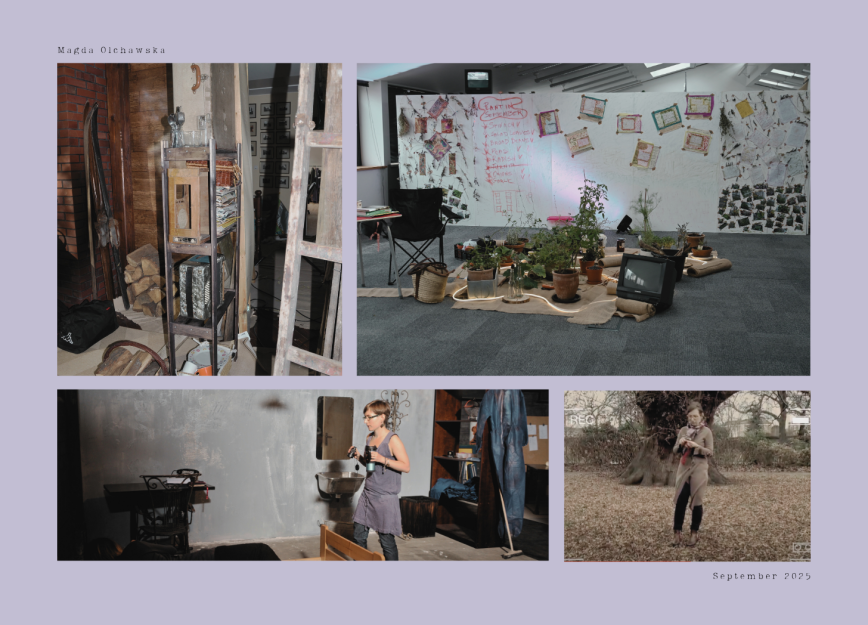
I fixed my cardigan and wore it for my first-ever art exhibition (I went back to Uni in September 2021). I loved fixing it, and I absolutely loved how it worked out (Photo below). This summer, I also received a knitted cardigan from my aunt, which she had made for herself in the 1980s. When I was growing up, I absolutely adored it and always dreamed of wearing it.
My aunt gifted me her cardigan. I just need to change the buttons, and I’m ready for the autumn 😊

I have also started using old clothes, mine and the kids to make artworks. It is a lot of fun, and the clothing items not only get a second life but also become part of something else, another cycle, another project, another breath of fresh air.
2021
I remember when, in primary school, they tried to teach us how to fix and mend things, but I was too busy with teenage life to learn.
2025
For the 2025-26 season (I measure years from September through July, when the academic year begins and ends). I’m learning how to sew. My mum used the sewing machine throughout the 80s, and my granny was a seamstress, so I have a feeling that I can pick it up easily. I just need to be patient.
2021
Luckily, YouTube will indeed show me the way.
Also, I will repurpose clothing that isn’t good enough to give away. If you have any inspiration or ideas for that, please share.
2025
I have been doing this by reusing the items to make artworks.
2021
Minimalist life choices—I started living by that philosophy early in my adult life, but I still made a lot of crazy, destructive decisions. I always preferred to spend more money on good-quality goods, such as clothing and kitchenware. But at the same time, I stupidly bought into Gap every time they had something on sale, and they often did.
Minimalistic life choices allow people to focus more on quality than quantity. Focusing on longevity should be the priority of all grown-ups on this planet if we are to save this amazing green space for our kids and grandkids. Yes, of course, cheap throwaway goods might be fun, but they don’t help anyone; charities cannot sell them, and often they’re unrecyclable.
I like having clothes and house/kitchenware that last for longer than a season, and I don’t care what the fashion influencers say about trends; just be aware of who pays them.
More people should start to buy for life, not for fashion. If you feel pressured to buy and spend, wait a day or two before deciding. The urge will more often than not pass.
I don’t want my short time on Earth to be masterminded by marketers from offices in Paris, London or New York.
2025
Well, I have not changed my approach at all. Since I don’t live in a big space, I can’t buy too much, which is a good thing for my finances and the planet. I’ve learned more about repurposing items and always checking with others to see if they have something I might want that they no longer need or use. I have also been re-gifting gifts a lot more, and I even went as far as to ask my friends not to give me anything for my birthday or Christmas; most of the time, they respect that. When it comes to offloading my unwanted items to charity shops, I’ve become very aware and conscious of the fact that charities have difficulties and are overwhelmed with the number of items they receive. Now I’m trying to find a specific person or organisation where I can donate the items. It surely makes me feel less guilty.
Since I wrote this post in 2021, I have been shopping with more consciousness. Of course, there are items I would rather not buy, such as school uniforms, but as of this writing, I have no choice. There are items my kids buy for themselves that I disagree with, such as Lego (way too much Lego) or magazines (OMG, don’t even get me started on my disdain with the magazines).
But overall, I’m really happy I embarked on a conscious consumer path. It required a lifestyle change and a mind shift, which didn’t happen overnight for me. Because I allowed myself the time and space to learn, be imperfect, and make mistakes, the transition from overconsumption to conscious consumption has been pretty smooth.
PS. I’m made by Made by Dyslexia, so expect small typos and big thinking.
Leave a Reply